My Journey Through Early Menopause: What I Wish I’d Known
Early menopause at 38 left me lost and struggling—until I found the truth about hormone therapy. Here’s what every woman needs to know when it comes to Perimenopause and menopause and your body.
I was 38-years-old when I was thrown into menopause. Thanks to radiation treatments for anal cancer, my body was pushed into it suddenly—right at the beginning of the pandemic. Navigating cancer during a global health crisis was one thing, but being catapulted into menopause without any support from my doctors at Kaiser?
… That was a whole other nightmare.
My doctors did NOT warned me about the side effects of early menopause or how much it would mess with my body. I didn’t even know what perimenopause—the period when your body starts to show early signs of menopause, like irregular periods and hot flashes—was, let alone menopause. I had to figure that out on my own, and it took time to connect the dots. It took more time than it should have because I literally went to see a woman doctor at Kaiser to discuss menopause and treatments, and all she wanted to talk about was hot flashes. Never mentioning the LOOOOoooNnngG list of symptoms that are associated with the lack of estrogen in our bodies. I had to learn more about those on my own - from TikTok, which finally gave me the information to take to my doctors to see a doctor who could answer my questions finally.
When Menopause Comes Crashing In
So, here's what I’ve learned: Menopause before 40 is considered "early" or "premature menopause." If you’re like most women, you expect menopause to hit sometime in your 50s, but when it’s induced by cancer treatments like radiation or chemotherapy, it shows up fast, and it’s a different beast altogether. Research shows that going through menopause early can make your body age faster—by as much as nine years compared to women who go through it later.
Now, before menopause, there's perimenopause. Perimenopause is the time leading up to menopause when your hormones start to shift. You might notice irregular periods, hot flashes, mood swings, or trouble sleeping. Your body is basically sending you little hints that menopause is coming. But in my case, there was no “peri” phase; I went straight to the main event. And I didn’t realize how much it would affect my health until it was too late.
What I Went Through
With zero prep and my hormones in freefall—estrogen, testosterone, you name it—my body felt like it was in open revolt. Here’s a closer look at what I went through:
Fatigue and Brain Fog: For me, this was the biggest and most concerning symptom of menopause. I was genuinely worried that I would never be able to work again or feel like myself. There were moments where I’d be staring at my own hand, and I couldn’t remember the word for it. The word would be right there on the tip of my tongue, but it just wouldn’t come to me. Concentrating on work was almost impossible. At the time, I thought this cognitive decline was due to my cancer treatments. I had no idea that it was actually from a lack of estrogen in my brain due to menopause.
Since it was during the pandemic, I wasn’t seeing many people, but I spent most of my days asleep, thinking that might be the rest of my life. Thankfully, once I started hormone replacement therapy, I felt better. But I know this will be a lifelong challenge. I have to manage it with healthy habits: exercising, eating well, getting good sleep, and keeping my brain engaged through social activities.
Bone and Joint Pain:
The bone and joint pain didn’t hit immediately; it crept in a few years after my treatments. My hips and other joints were constantly achy, a dull discomfort that seemed to settle in. For a while, I found myself avoiding certain activities, like climbing stairs or carrying heavy groceries.
But over time, I’ve worked myself back into better habits—hiking, daily mobility exercises, and strength training. Still, this is something that’s going to impact me for the rest of my life. I’m working on it now, but it’s not something that just goes away.
Heart Health Concerns:
Heart health is a big issue for many people in menopause, but thankfully, it’s not something I’ve experienced yet. I didn’t have symptoms like dizziness, headaches, or palpitations, but I’m definitely concerned moving forward. I’m only 43, but it already feels like I’ve aged ten years from the cancer treatments, pandemic stress, and being thrown into menopause. I worry about what the future holds if I don’t stay proactive.
Mood Changes and Anxiety:
For me, it wasn’t really about mood swings; it was more of a constant, heavy feeling—like I was just not excited about anything. It was less about snapping at people or having emotional outbursts, and more about feeling totally drained and uninterested in everything. It was relentless.
Honestly, it was all-consuming until I found the right doctor. She was the first one to really explain what was happening with my body. Instead of just talking about hot flashes—because, by the way, mine completely stopped once my body adjusted—she helped me understand that hot flashes are like our body’s initial alert system that something is wrong. Once I found the right treatment and got on hormone replacement therapy, things started to improve.
Finally, a Doctor Who Listened
For over a year after my cancer treatments, I was stuck in this fog with no answers. Kaiser didn’t give me any direction on how to handle menopause, much less the symptoms that come with it. I finally found a doctor who listened—really listened—and suggested hormone replacement therapy (HRT). She explained that my body needed hormones it suddenly lost.
One day on estrogen and testosterone, and I felt like I’d just chugged an espresso after a year in a caffeine-free zone. My brain cleared, my mood lifted, and my body didn’t feel like a stranger’s anymore.
Educating Myself and Spreading the Word About Perimenopause & Menopause
Since then, I’ve made it my mission to learn about menopause and to speak up, not just for myself but for other women. Here’s the reality: Most doctors aren’t trained to manage menopause or don’t consider it a priority. If I hadn’t pushed and kept searching, I’d still be wandering around in that fog, exhausted and clueless. But now I am using my platform to speak up about menopause and listening to our bodies.
What You Should Know about Menopause
When it comes to navigating menopause, you quickly learn that what got you here won’t necessarily get you to the next chapter. The old routines—what you ate, how you exercised, or how you dealt with stress—might not cut it anymore. Menopause changes the game, so you need to change with it. Here’s what I’ve learned about adapting and thriving through this quick transition (but for most, its a long, slow transition):
Learn the Basics: Understand what menopause and perimenopause actually mean. Perimenopause can start years before actual menopause, with symptoms like hot flashes, mood changes, and irregular periods. Talk to your friends—many are going through it, too. Dive into TikTok or Instagram where real women share their stories and practical tips. Write down questions as they come to you and bring them up with your doctor. Knowing what’s happening in your body is the first step to dealing with it. And don’t settle for vague answers.
Find a Doctor Who Gets It: Not all doctors are up to speed on menopause, and some may dismiss your symptoms or act like you just have to live with them. Newsflash: you don’t. Find a healthcare provider who takes menopause seriously, listens to you, and understands that your experience is real and valid. Sometimes this means switching doctors or even seeking out specialists in women’s health or menopause care. Remember, you're the customer here—don’t be afraid to shop around.
Look Into Hormone Replacement Therapy (HRT): For many women, HRT can be a game-changer, but it’s not a one-size-fits-all solution. If it’s safe for you (i.e., you don’t have a history of breast cancer in your family, etc), HRT can help balance the hormones that are causing chaos in your body. The key is finding a knowledgeable doctor who can personalize the therapy to your needs and monitor your progress closely. HRT is a big decision, so make sure you get all the facts and weigh the benefits and risks carefully.
Speak Up: Don’t be afraid to talk openly about what you’re going through. Ask questions, demand clear answers, and keep pushing until you get them. Share your experiences with your friends who are in perimenopause or approaching it. It’s incredible how much we learn from each other when we’re honest and open. Many of us are in the same boat, and the healthcare system often leaves us to figure it out alone—so let’s make sure we’re helping each other.
Healthy Living: Adapting to the New Normal:
Healthy living looks different in menopause. What used to work might not be enough now. Here are some steps I’ve taken to adjust my lifestyle and feel better:
Revamp Your Diet: Your body’s needs change with menopause. Focus on foods rich in calcium and vitamin D to protect your bones, and eat more fruits, vegetables, lean proteins, and whole grains. Cut back on processed foods and sugar, which can trigger hot flashes and weight gain. Staying hydrated is crucial, especially if you’re dealing with hot flashes.
Stay Active, but Smart: Regular exercise is non-negotiable. But, if you’re like me and suddenly find that intense workouts leave you feeling wiped out, it’s time to adjust. Aim for a mix of strength training, cardio, and low-impact exercises like yoga or Pilates. These can help with bone density, heart health, and managing mood swings.
Prioritize Sleep: Good sleep is harder to come by in menopause, but it’s also more important than ever. Try creating a bedtime routine—no screens an hour before bed, a cool and dark room, and maybe some calming activities like reading or meditation. If sleep problems persist, talk to your doctor about other options.
Manage Stress: Menopause can mess with your mood, and high stress only makes it worse. Find what calms you—whether it’s walking, meditation, breathing exercises, or a creative hobby—and make it a part of your daily routine. Stress reduction isn’t just nice to have; it’s a must-have for your overall health.
Know Your Numbers: Regularly check your blood pressure, cholesterol, and bone density. Menopause can impact these areas, so keep track and make sure you’re on top of any changes. Don’t wait for a problem to pop up—stay proactive about your health.
Don’t Stay in the Dark When It Comes to Your Body
Now at 43, I’m still dealing with the effects of early menopause, but I’m not in the dark anymore. I’m learning how to take care of myself and trying to help other women avoid the same pitfalls. If there’s one thing I’ve learned, it’s that we have to advocate for ourselves. Don’t wait for someone else to fight your battles—take charge of your health, because no one knows what you need better than you.
Sources:
American Heart Association. (2016). Menopause and Heart Disease.
Maki, P. M., et al. (2019). Menopause and Cognitive Decline: The Role of Estrogen. Journal of Women’s Health.
U.S. National Library of Medicine. (2018). Early Menopause and Bone Health.
The more we talk about menopause and perimenopause, the less we have to suffer in silence. It’s not just an ending; it’s a change—and with the right support, it doesn’t have to be scary.
Reflecting on Two Years Since My Anal Cancer Diagnosis: Pivoting my Business
I found out I had anal cancer two years ago this week, and my life and business have pivoted to focus on more of the values I hold true.
It’s been two years since I was diagnosed with anal cancer. Shortly after my diagnosis, I went through a month of cancer treatments: oral chemotherapy and radiation on my pelvis. And after that, I was bedridden for about a month and a half.
I’m not gonna lie, I went in thinking that I would be back to "normal" in six to eight weeks post-cancer treatments.
Two years later, my life is anything but normal. It took me a while to regain strength in my hip muscles, slowly taking walks around the block, hiking around my neighborhood, and finally getting back into my favorite classes at the gym, starting with Silver Sneakers classes with people 60+ years old. Now I try to make it to a HITT workout class two times a week.
My digestion is chronically poor, and I just have to be more careful about what I eat and drink.
Additionally, my outlook on life has changed.
The pandemic and cancer treatments reframed the work I do and what I focus on.
Pivoting my social media marketing business
I still teach social media marketing to small business owners and marketers, but my focus has shifted to mental health struggles and helping people build confidence when creating content for social media. For me, it's all about teaching people to be more effective in their efforts and less overwhelmed by the amount of tasks.
In my work with clients, I often see how much stress and anxiety is caused by social media.
There are so many demands placed on social media marketers to be constantly available and responsive, to post regular updates and engaging content, and to keep up with the latest changes in the algorithms and trending topics. It's no wonder that so many people feel like they're never good enough or doing enough with promoting their business online.
My goal is to help reduce some of that stress by providing actionable tips and strategies that can be implemented immediately, as well as a more long-term view of social media marketing. I want my clients/students to understand that there is no "perfect" way to do things—but there definitely are ways that are more effective than others.
And, most importantly, I want them to know that they are capable of creating successful social media campaigns…even if they don't feel like it sometimes.
I didn’t realize I was making this pivot at the time; I just knew that there were lessons I had learned and wanted to share with others.
Instagram in real life…really
Further, I've made a concerted effort to talk about the hard stuff on social media. In the past, I would try to put a rose-colored filter on posts because I didn't want to risk losing clients because they saw me struggling in my personal life (especially after my son was born).
Going through cancer treatments taught me that I could be authentic and tell my story—the good, the bad, and the ugly—and find that people could relate.
Finding my passions
While I was bedridden, and in the years since, I had a lot of time to reframe how I show up in my business. How I bring the things I am passionate about to my job as a marketing educator and freelance writer.
The thing that has become most important to me is my “why.” Why do I do what I do?
I want to be clear about that because it's easy to get lost in the “doing” and forget why you're even doing it in the first place. For me, it's always been about connections and helping others in whatever capacity that may be.
When I was bedridden, I didn't have any choice but to sit with myself and really think about the direction I wanted my life to go in. And mental health just kept coming back to me as something that I wanted to talk more about.
For small business owners and marketers, but also for kids and parents.
I see so many people struggling with their mental health, and I just want to help in whatever way possible. Whether that's through the children’s books about bugs, big feelings, and coping skills for kids that I have published, freelance writing, or helping others understand that it's okay to ask for help.
… It’s also about encouraging others to bring their passions into every part of their lives.
I’m not here to tell you to quit your job and completely pivot your business. You don’t have to do that to make a change in your life.
When you bring more of yourself to your work, you’re creating a bigger sense of purpose, which means you’re going to be more excited about the work that you’re doing on a daily basis. This is good for you and for the people around you, including your family and your employer.
There is no one-size-fits-all solution for making major changes in your life, but there are some general principles that can guide you through the process.
Tips for making space at work for what you’re passionate about:
First, you have to truly understand what you’re passionate about. It’s important to be honest with yourself about what you value. Spend 15-30 minutes of dedicated time at a coffee shop or your favorite happy hour, alone or with friends/family/coworkers, and start asking yourself questions.
What makes you happy? What do you love doing? What makes you feel alive and excited? Here are some more ideas to get you started with writing a list of what you value. Write down whatever comes to your head!
Read your list aloud and circle the three to five things you’re most passionate about. Start brainstorming ideas for how you can incorporate those passions into your day-to-day life. Don’t try to circle too many values at once because it can get overwhelming. This is about creating small steps.
To start, try setting aside 10-15 minutes each day to pursue your passion outside of work hours. This can be something as simple as painting during your lunch break or hiking after work. By incorporating your passion into your daily routine, you will feel more fulfilled both inside and outside of work.
You can also try to find ways to incorporate your passion into your work life. For example, if you’re passionate about environmentalism, see if there are any eco-friendly initiatives you can get involved with at work. Or if you love writing, offer to write blog posts or articles for your company website. By using your skills and talents for the benefit of your workplace, you can create a more positive and productive environment for yourself and those around you.
Get started. If you want to make space for your passions at work, you simply need to start. It may seem obvious, but the hardest part is making your passions into habits. Once they become a part of your daily routine, you'll be able to do them without even thinking about it.
Can you take on additional assignments that relate to your interests? Or, even better, can you outsource some of the projects that you hate doing so you can spend more time on the tasks you enjoy or are good at? Are there networking opportunities available in your field that can connect you with like-minded individuals?
Don’t be afraid to speak up and advocate for what you’re passionate about. If there’s an issue or cause that you feel strongly about, let others know and see if they’re interested in getting involved as well. You never know who else might share your passions, and by working together, you can make a real difference.
It can be easy to get caught up in the hustle and bustle of day-to-day work life and forget about what you're passionate about. If you find yourself feeling unfulfilled or unhappy at work, take a step back and ask yourself if you've been incorporating your passions into your daily routine. Chances are, you may have let them fall by the wayside in favor of more pressing obligations.
If you’re starting to see a pattern of multiple bad days, don’t feel discouraged. We all go through seasons like this in our lives, and instead of starting back at the drawing board, ask yourself how you can make small steps to bring your passions back into your life.
Try scheduling a once-a-year session to reflect on what has and hasn’t worked over the past year (I am now trying to do this every six months). Create a space to pause and see if the values and passions that you originally came up with remain relevant, or if they need to be altered.
That’s okay if they do. We are always changing, and while your core values probably don’t change much, what you want to do with them may. Taking the time to reassess your life and what you want to accomplish can be incredibly difficult, but it is so worth it in the end. You get to decide what makes you happy and fulfilled, and that is an amazing gift.
Remember that bringing more of yourself to your work is simply about being authentic and true to yourself. When you do that, it not only makes your work better, but it also makes working a lot more enjoyable for everyone involved.
You don’t have to go through a crisis like getting diagnosed with cancer to reassess your priorities and think about what you really want out of life. You have permission to take a step back now, examine what your passions are, and find exciting ways to use them to create a fulfilling future.
Tips to Help You Get More Fit After Anal Cancer
Here are simple tips to help you start getting fit after anal cancer treatments. Even if most days feel like no progress has been made, slow & steady exercise can help both your physical and mental self. Moderate exercise can go a long way in helping you to improve your quality of life post anal cancer.
For those who have recently been diagnosed with anal cancer, exercise may be the last thing on your mind. It's common to feel overwhelmed and unsure of what to do next.
I wrote about my experiences learning I had cancer for Cancer Wellness Magazine and my own blog. If you or someone you know is recently diagnosed with anal cancer, I would suggest reading either one of those for tips I learned during my anal cancer treatments.
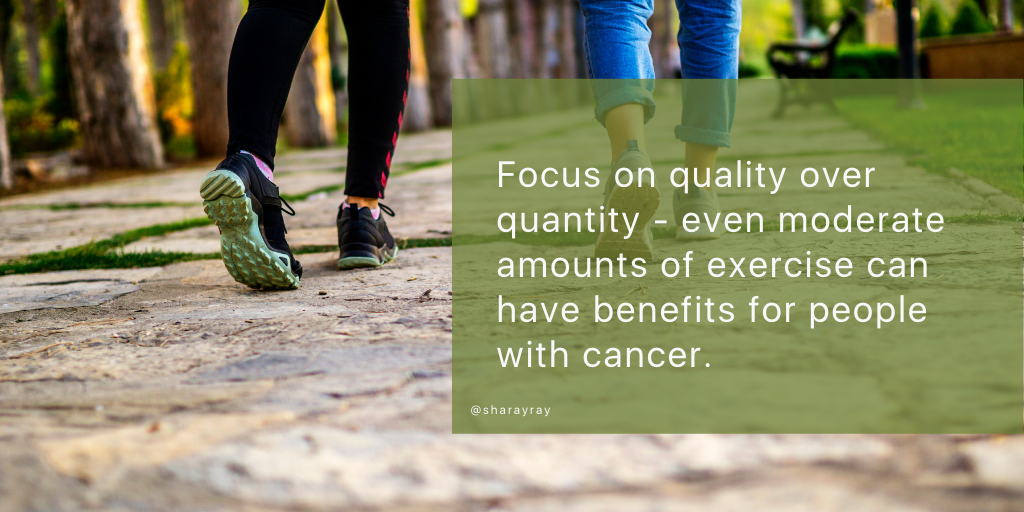
Talk to your doctor about whether exercise is right for you. If so, there are some things you should keep in mind when starting an exercise program. First, start slowly and build up gradually. Secondly, choose activities that you enjoy and that fit your fitness level. And finally, focus on quality over quantity - even moderate amounts of exercise can have benefits for people with cancer.
At the beginning of treatments, try to eat healthily, stretch, and take moderate walks when you aren't sleeping. And towards the end of radiation treatments, and the few weeks after - just try to rest as much as possible to get through it all.
So what are the best types of exercise to do if you have anal cancer?
I am going to say it again — it’s important to talk to your doctor or physical therapist to get clearance before starting any kind of exercise program. Once you have the green light, start off slow.
Walking from my bed to the kitchen was a milestone I was proud of which I was able to accomplish about 2 weeks after treatment ended (prior to that I was completely bedridden with a few trips to the bathroom).
Moderate aerobic activities like walking or swimming are great options once you are feeling up for it. These activities will help increase your heart rate and oxygen levels, which can help reduce fatigue brought on by your body literally focusing all of its effort to shrink a tumor.
For me, the more I walked - even if it was slowly down the block and back - the more I felt like myself again.
Once your treatment rounds are healed, strength training is important for anal cancer survivors
In addition to aerobic exercises, strength training is also important for cancer patients. You don't have to lift weights or use those confusing bands. There are many bodyweight exercises that have helped me.
This 10-minute standing abs workout from PopSugar Fitness is a video I put on at least once a week.
Standing while working on my core is needed because I tend to get dizzy doing crunches on the ground.
Strengthening your core, glute muscles, and your hips can help to preserve muscle mass and bone density, both of which can decline during cancer treatment. This video has continued to help me as I hit 1.5 years post-cancer treatments.
It’s important to start slowly with strength training, especially if you are new to it. Talk to a personal trainer or physical therapist about the best exercises for you and how to do them correctly. Once you have the hang of things, you can begin to increase the intensity and frequency of your workouts.
A healthy diet helps improve your overall health and can also reduce your risk of recurrence and death from anal cancer. Eating plenty of fruits, vegetables, whole grains, lean protein, and healthy fats can help improve your prognosis and quality of life after being diagnosed with anal cancer. Here are some of the healthy eating tips I learned. For me - I have upped my fiber intake, but I know for many with anal cancer, they have to do the opposite, so once again - talk to your doctor. <3
Also, flexibility and balance exercises are also beneficial for those with anal cancer. Yoga, Tai Chi, and Pilates are all good options that can help improve some of the physical side effects of cancer treatment, such as fatigue, pain, joint stiffness, your range of motion, and reduce the risk of breaking a hip (and yes! post-radiation on your pelvis, this is a huge concern for anal cancer survivors).
Exercise is important for anal cancer survivors, both mentally and physically
Cancer patients often experience anxiety and depression along with their diagnosis. Exercise has been shown to help lessen these symptoms by releasing endorphins, which have mood-boosting effects. Endorphins can improve your overall outlook and make you feel happier.
Endorphins are released from your brain when you do something that's physically or emotionally stressful. For example, if you exercise intensely, your mind will release endorphins to protect your central nervous system.
If you are struggling with motivation, try working out with a friend or joining an exercise group specifically for cancer patients. It can be helpful to surround yourself with others who understand what you are going through and can offer support and encouragement.
Acupuncture helps also! I go once a month and it makes a world of difference.
Don't be afraid to get moving! Moderate exercise can go a long way in helping you to improve your quality of life. Even if you’re not feeling up for a vigorous workout, moving in some way is important for both your physical and mental health.
Try starting with a 2-minute stretch, and 8 minutes of walking and gradually increasing as you feel able.
If you (or someone you love) are newly diagnosed with anal cancer:
Here are some articles I have written on my journey. I hope I can help many people, during and after treatments. <3
One year Since my Last Day of Anal Cancer Treatments
One year ago I rang the bell at the Kaiser cancer treatment center. One year ago I finished my anal cancer treatments - radiation & oral chemotherapy. And now, one-year post anal cancer treatments —Moving forward, one of my goals in life is to encourage everyone to listen to their body, and go see a doctor, community health center, etc when they feel like something is off.
One year ago I was in the worst pain of my life.
One year ago was my final day of radiation/oral chemotherapy anal cancer treatments (read more).
One year ago, I thought it would be back to “normal” in a few weeks.
Yesterday, a journalist for ACB 7 News interviewed me (and Ryeson about the Randall the Blue Spider Goes Surfing book) and commented that I was so happy & smiling even though I have gone through hell and back over the last year +.
My response to her: Moving forward, one of my goals in life is to encourage everyone to listen to their body, and go see a doctor, community health center, etc when they feel like something is off.
I have to smile because if I don’t, I’ll tear up. 🥰🥺
Even though the worst pain of my life was a year ago, there are definitely mental health issues, physical therapy, and some brain fog that may impact me for years to come —
But.
I understand the importance of health more than ever. I also have a 2nd children’s book on the way (yay) and a relatively healthy family that I am going to spend a lifetime advocating for.
I wanted to spend today celebrating with friends and family. But instead, I’m gonna go make a protein shake and try not to tear up. 💙🤞
Bottoms Up! Post-Anal Cancer Life One Year Later
The post-cancer journey is a slow and arduous one. It's hard knowing that I may not return to my pre-cancer "normal" in some ways. But all you or I can do is approach every day in turn—and with diligence, focus, and people by your side, things become a little less tough than they otherwise would be. Sometimes, that's all you need.
It’s been just over one year since I found out I had a tumor living in my pelvis. One year since hearing those dreaded words from the doctor: “You have cancer.”
One year since the whirlwind of doctors appointments, tests, scans, and starting cancer treatments—30 days of radiation, daily oral chemotherapy pills, and two transfusions of chemo.
It may be one year since I found out I had cancer, but it’s been 10 1/2 months since the last day of my cancer treatments, the most painful month of my entire life, and the slow recovery of getting my mobility and brain back.
Post for Anal Cancer Treatments
It is hard to prepare anyone for going through cancer treatments because cancer is so different for everyone who has it. But there were a few things that I knew going in, and a few things that took me by surprise. I have written about the many things I learned during my anal cancer treatments; I had heard that the first two weeks after treatment would be the hardest, but nothing could have prepared me for how I would actually feel when the time came.
I really thought that, after a month, I would have been moving around more. It took closer to three months— to simply be able to walk around the block and that was after a focused effort to eat healthy (for energy) and slow movement every day.
Even now, one year later, I have to stretch and do mobility exercises daily. I have to eat healthy and move around because my digestive system is not what it used to be.
I even took a class at my local gym and couldn’t keep up with women who were 30 years older than me.
The brain fog lifted after a few months, but when I talk, it’s sometimes harder for words to come to me. (This doesn’t happen when I write, only when I speak.)
And post-cancer menopause is definitely no joke. The term “hot flash” is exactly what you think it would be: this internal heat takes over every part of your body for a minute or so, and then it goes away as quickly as it came. I can be in the middle of talking and need to walk away to find a cool spot or lie down.
I’m pretty sure there are other side effects, but I honestly can’t tell what stems from post-cancer life versus menopause versus random anxiety about raising a family in the COVID pandemic.
Immune System Support Post Cancer
I sometimes have to remind myself that while my focus is on being healthy and happy with my family, that doesn’t mean that those things are always easy to obtain. I am still going to crave chocolate or have too many beers (which now unfortunately means that I literally can only have two beers without being hungover. Two and a half, and the next day I feel like absolute crap).
Image of a tweet from @ilanamuhlsteinrd
This also goes for anything sugary. I’m mourning the fact that I can’t eat sugar like I used to. But, my brain knows that that’s a good thing because sugar is not good for anyone. I am still sad about it because as bad as sugar is, it tastes even better…
I’m now at the point where having even a little bit of cake means that I crave it for the next few days and get headaches when I don’t consume more sugar. Damn sugar hangovers are almost worse than alcohol hangovers.
Jumping Back into Everyday Life Post Cancer
I’ve written a few articles about my post-cancer life on this website, Cancer Wellness Magazine and the East Bay Express, and even talked about it on TV on Good Day Sacramento, along with a few podcasts. Having to step back from my work meant that I was able to publish Randall the Blue Spider Goes Surfing, and watch it go to a #1 Best Seller on Amazon -- and that wouldn’t have happened if it weren’t for being forced to say goodbye to clients and gigs because of cancer and the coronavirus.
I am truly grateful for that opportunity, and for the chance to ascertain what’s really important in my life.
I found out the tumor was gone one week before the children’s book came out. That is now three months of not dreading the possibility that the cancer treatments hadn’t worked and I would have to have surgery to take the tumor out. I still worry on a daily basis, especially because the coronavirus hasn’t gone away.
I’m also having trouble trying to figure out how to talk to people about my cancer.
Because we’ve been in lockdown for the past year and a half, I’m just now learning to talk about my cancer with strangers. I have this visceral urge to tell everyone. I want to explain why it sometimes takes me a bit to get from one place to another, or why I started crying in the middle of an exercise class (hot flashes).
Regardless, I am a year out from hearing the life-altering words “you have cancer,” and I am making sure to talk about it, to normalize discussion of anal cancer, to advocate for listening to your own body (even if test results are telling a different story, push your doctors if you feel something is off).
The post cancer journey is a slow and arduous one. It's hard knowing that I may not return to my pre-cancer "normal" in some ways. But all you or I can do is approach every day in turn—and with diligence, focus, and people by your side, things become a little less tough than they otherwise would be. Sometimes, that's all you need.
Tips I Learned During Anal Cancer Treatment
I will say that no matter how horrible the days were, they went by quickly, and there is a light at the end of this tunnel. My type of stage III anal cancer has a good chance of recovery—even if that recovery means that I still have to have surgery in the future.
As you might have seen when I announced that I had anal cancer back in July, I've been very vocal about what treatment looked like and what post-cancer life looks like for me.
I have shared my story on social media as well, and with that I have received many messages from people I know, telling me my advice has been helpful. I have also talked with people I didn't know who were reaching out to ask for tips during cancer treatments because they or someone they loved was going to go through anal cancer treatment—and they just wanted to talk. I have even had a woman reach out because, apparently, my blog now comes up pretty high under the search term “anal cancer treatment.” So who am I to deny this underutilized SEO term? (lol)
Finding Out You Have Anal Cancer Is Scary
Especially when your doctors start telling you what treatment looks like —- radiation, chemo, dilators, creams, medicine, etc. (read more about how I found out I had anal cancer). It was a whirlwind of information, and it all happened so quickly that I didn't really have a lot of time to process what was going to happen to me during anal cancer treatments. It really wasn't until after my radiation burns on my pelvis started to heal and my energy levels started to increase (which occurred a month or two after my last day of treatment) that I could begin to internalize the fact that my life post-treatment is different.
What has helped me is being able to provide some tips I have learned over the past few months and giving advice to anyone who's willing to listen.
Anal Cancer Treatment Advice:
I have copied and pasted this advice to three different women, so I figured it would be important to share here as well. Before reading, please know that this is advice from my experience of going through intense radiation, along with less intense chemo pills for 30 days, and being bedridden.
Everyone’s treatment schedule is different, and so my best advice to you is to ask your doctors as MANY QUESTIONS AS POSSIBLE and work with them on a good plan for your needs.
The week before and three weeks after my final day of anal cancer treatments, I was bedridden because of the pain from the radiation burns. I didn't want to move at all. Thankfully, because my body was exhausted, and with the medication, I slept through most of it—aside from getting up to use the bathroom (which was the worst part of my day). That month I just drank protein shakes for sustenance because "real food" made my bowel movements even more painful.
Get a day planner or notebook to write down the TIME you take all your medications each day (you can also include times for bowel movements, what you ate, and how you felt throughout the day). At one point during the worst of it, I was taking 6 different pills every two hours. There is NO WAY I could have independently remembered all of it.
Medication makes you constipated, so figure out what makes sense for your body. I prefer not to talk about it, but I'll just say that ex-lax and stool softeners helped to balance the morphine. Don’t forgo certain medications because they make you constipated—figure a way to balance it.
Get a medication caddy (okay it’s really a shower caddy) and a label maker to add the name of each medication to the top of the pillbox - this is helpful for you when you are super “foggy” and your caretakers. Thank you Melody for this suggestion. <3
Talk to your doctor about when you should start using the dilator - everyone I have talked to seems to have heard something different from their doctors so work with them for the best treatment for you (I started 6 weeks after my last day of treatment, but some start during treatments).
Walk around as much as you can. Stretching is key! Once bedridden, you won't be able to do either, so try to get out as much as you can. Look up stretches from bed on YouTube and try doing them while bedridden (if you can—don’t push it).
And during the time you are bedridden (or at least stuck close to the bed), don’t bother with pants. I either wore a long t-shirt or really soft pajama shorts when I could. And I wore the shorts under my sweats when I had to go to doctor’s appointments because regular underwear was too tight.
Your oncology nurses/doctors will recommend different ointments for your radiation burns. Use them liberally. Flushable wet wipes are much better than scratchy tp. Invest in several packs (especially important during a pandemic when people are hoarding tp, etc).
Acupuncture is GREAT for aches, pains, and stress. Start with this treatment in conjunction with your regular cancer doctor’s visits (and see if your insurance covers part of it!).
Get a sitz bath to go over your toilet. The salt will help with the radiation burns. If it burns when you urinate, pee in it with cold water. It’s kind of like peeing in a pool, but it helps so much. Get the bath and salt here.
Work with a loved one on all aspects of life (driving to appointments, childcare, making dinners, etc.) because you will need help with a variety of things, and talking it through beforehand helps to mitigate any bumps once you start feeling really weak. My husband took care of the four-year-old, me, and himself for the month I was in bed, and it wasn’t easy—but the restaurant and grocery delivery apps definitely helped to make sure he didn’t go hungry while he was taking care of everyone else before himself.
Schedule time for others to help out. We created a calendar with friends and family to help drive me to appointments and take care of Rye/Jeff/myself, and it was so helpful to have them all. They ALL took COVID tests and quarantined before coming to see us. You will need the most help in the last week of treatments and the following month right after radiation ends.
If you have long hair and are not losing it due to chemo, have someone brush your hair every day. During the worst of it, I couldn’t shower, and I could barely get up. I ended up with two very large dreadlocks, and once it was too late, I couldn't get them out on my own. I was too weak, and so I needed professional help. Thankfully the amazing team at The Beauty Spot Santa Rosa was able to comb most of it out, and they only cut out a chunk in the back of my head. I can comb some of my hair over and it looks pretty normal. This is a random piece of advice that I doubt anyone would think about beforehand.
It took about two months out of treatment to start feeling "normal” (which is a relative term in 2020, of course, because nothing feels normal). I really thought I would be back to work after two or three weeks, but my body and my mind had other plans. Talk to your employer to see if you can ease back into work life, because the brain fog and fatigue is real, but it does go away.
Get over being embarrassed about talking about symptoms, treatments, and anal cancer in general. I talked about poop more in the past few months than I did when my son was born. And I get it: it's embarrassing to admit you have anal cancer, even more so because it’s derived from having HPV. But, the more we weaken the stigma surrounding it, the more people may get their symptoms checked early (my symptoms were hemorrhoids). I also just found out that Marcia Cross (the redhead from Melrose Place and Desperate Housewives) had anal cancer back in 2017. She has done a great job of sharing her own story.
Even More Anal Cancer Treatment Advice with a Focus on Eating:
For the most part, I didn't have an appetite and nothing tasted good. It VERY much reminded me of being pregnant. Certain smells would make me hate a specific food, so I stuck with lots of oatmeal and bland stuff to keep up calories. But, like I said, protein shakes kept me going! When you are in the lowest moments, don't focus on eating SUPER HEALTHY, just make sure you are eating enough. <3
In terms of eating right during treatment and after — stick to as many veggies as you can (IF YOUR nutritionist agrees - for some heavy fiber may not be a good idea). Currently, I am low-sugar, gluten-free, and no dairy (aka NO FUN) just to boost my immune system and energy for the next several months at least. I am super focused on getting 8-10 cups of fruits and veggies a day. That gets fiber in your diet, which is helpful for digestion (and digestion is one of the most important things to focus on when dealing with a tumor in your butt).
Protein/veggie shakes made sure I was getting enough to sustain myself. My personal favorite is the Kale & Protein by Amazing Grass (subscribe & save is awesome for buying this protein shake). I lived off of my protein shakes during the time when I was bedridden and eating anything felt like a LOT of work.
Eat a tablespoon of sauerkraut every day (personally, I LOVE Wildbrine’s Red Cabbage & Red Beet Organic Sauerkraut, which you can get at Whole Foods, or the Raw Green Organic Sauerkraut, which you can get a HUGE tub of at Costco or a small tub at Whole Foods). It is great for your GUT (and, in turn, is great for feeling better). Try eating more fermented foods in general. Even fermented pickle spears.
When it comes to health after your cancer treatments, think about the things that keep you healthy in general: eat your veggies and move around. Please know, however, that this is not me saying, “EAT KALE AND IT WILL CURE CANCER.” Eating healthily made me feel more like me. What you consume is about listening to your body. The other day, I had two pieces of cheese pizza, and my stomach, my sleep, and my bowel movements HATED me after. (But, it was delicious and worth it.)
Please remind yourself that it will take a while to find a groove again, and even longer to start feeling like “yourself.” For me, three months out, I can say I am almost there. Now I just need my tumor to fully go away (we won’t find out officially until about March 2021), and I can move on to the anal cancer remission stage.
These are just some of the tips I have provided in the last few months. It's definitely not everything. Communication with your doctor and friends is key.
I will say that no matter how horrible the days were, they went by quickly, and there is a light at the end of this tunnel. My type of stage III anal cancer has a good chance of recovery—even if that recovery means that I still have to have surgery in the future.
Hug your loved ones. Make sure to connect with your doctors and cancer nurses as much as possible - there is NO SUCH THING AS AN EMBARRASSING QUESTION!
And if you want to talk more about what to expect during anal cancer treatments, please know that I am here. @sharayray on Instagram or email me at shana@shanabull.com <3